Showing posts with label Fantasy Weapons. Show all posts

Wednesday, May 13, 2015

Weaponry Wednesday: The Kukri


Kukri’s are among the most badass blades of the knife world, combining the finesse of a knife with the power of an axe. The unique weight distribution and curving edge serve maximize the kukri’s damage output, offering more edge to cut and more weight behind the point of impact, simultaneously chopping and slicing. The result is that the kukri slides itself readily inside whatever, or whomever, it slashes and then slices the point of impact further open on its exit. Essentially this knife is a handheld guillotine.

The kukri has made several appearances in several science fiction and fantasy media, but it’s rarely given the same reverence or attention as the sword, possibly because of its association with assassins and service as a tool as much as a weapon. Noticeable users include Alice from the Resident Evil franchise and Game of Throne’s Bronn the sell sword; in fact this seems to be his go-to weapon as every time there’s trouble, his hand goes first to his knife.

Often compared to a machete, the unique shape of the kukri can make it difficult for inexperienced wielders to utilize properly. It was often used as an offhand weapon, the shape excellent for catching enemy blades while heavy enough to counter attack and deal damage with less expertise required than a typical dueling dagger. The weight also made it more durable and resistant to damage.  


Despite its incredible combat effectiveness, the kukri’s origins are actually rather humble and most commonly found as a farming tool, muck akin to a multipurpose sickle that could be used for harvest, slaughter, construction and other assorted utility purposes. In short, this is an ideal adventurer’s tool. Probably not a great primary weapon for a protagonist (unless they need it concealed and are the sort to prefer knifing), but I guarantee any farm boy with aspirations of heroism and a long journey ahead of him would fare much better with one of these.


Wednesday, April 22, 2015

Weaponry Wednesday: The Staff


Often over looked as a melee weapon and instead perceived as a walking stick, the staff is the iconic tool of the wizard. And let’s face it, rare is the wizard who is complete without his staff. Okay, Rowling did an excellent job of making the wand cool in Harry Potter, but I think we can all admit that a bunch of teenagers with big sticks that they can whack each other with. Actually that sounds like regular high school so never mind. My point is the staff is not exclusive to spell-casters and monks of the Far East and is often short changed as a pretty bad ass weapon.

The greatest benefit? It’s about as idiot proof as you can get. At its most basic, a staff is a long club. Also a cool walking stick, but essentially a club. No edge alignment to keep track of, no expensive material to care for, easy to replace and hard to hurt yourself with. Perfect for you newly minted heroic but accident prone farm boy off to slay the Dark Overlord of Whatever Land.


The defensive abilities of the staff cannot be overstated. To put this weapon in perspective, shepherds used to spend weeks at a time in the wilderness protecting flocks of sheep with nothing more than one of these to keep wolves at bay. The shepherd’s crook is essentially a staff with a hook shaped design at the end for grabbing stray sheep, not especially intimidating but incredibly effective in the right hands. The simplistic design of the staff (shepherd’s crook or otherwise) makes it easy to learn to use, meaning mastery is achieved at a faster level. Combine that with the weapon’s impressive reach and a practiced wielder can create a veritable “no fly zone” around them in terms of weapons. Arrows may still be a problem, but if you’re taking a staff to a bow fight then you’ve got bigger problems to worry about.

In terms of versatility, you will be hard pressed to find a more variable weapon. The staff lends itself to simple sword-like swings from one end, spear-like thrusts, and spiraling twirls from a central grip, each of which are simple to switch between. This means that the staff is adaptable, capably of being used indoors or out, against a singular opponent or multiple, and the wielder can readily adapt their strategy depending upon their opponent’s armament and attack patterns.

The staff’s greatest flaw is its lack of lethality. While its versatility and reach provide for a staggering variety of attacks and combinations, rarely does a staff kill. That’s not to say that a staff can’t kill; only that it’s not a likely candidate for this year’s Miss Lethality Pageant. This was one of the reasons for the staff’s popularity among Far East monks and why there were rarely any legal issues with traveling with one. Staves could bruise or even break bones, but most wielders were forced to wear their opponent’s down or disarm them.


In short, the staff is an excellent weapon for anyone who is looking to either not kill their opponent or to simply escape. It’s versatile, simple, and provides a defense that is difficult to overcome, but lacks ready lethality. What are some of your favorite staves from mythology and fantasy literature? Gandalf’s is a given, but I got to hand it to the Monkey King, Sun Wukong for his Riyu Jingu Bang a staff that could adjust its length and weighs an easily manageable 17,550lbs. Comment below!


Wednesday, April 15, 2015

Weaponry Wednesday: The Katana


Made popular to the Western mainstream audiences by its appearance in The Highlander (also responsible for the popularity of trench coats), the katana has fascinated sword-lovers for years. Easily one of the most recognizable and popular swords in existence, it has set firm roots down in the fantasy literature community. In fact, the popularity of the weapon is so great that criticism of it is often met with anger. Hopefully I do not offend anybody with this piece, but I don’t think I’ll lose any sleep if I do. If you think that my analysis of the katana is incorrect or you have something to add, please comment below and let me know!

Rare is the sword that can surpass the katana in terms of history, so steeped is the katana in tradition and mythology. First used around 800 A.D. in Feudal Japan, a passing glance suggests that this weapon is like unto a shark among swords; it has not evolved since conception because it hasn’t needed to. This is not quite true. Japanese sword smithing is absolutely amazing, especially given the limited resources available on an island, and has subtly but distinctly changed the katana over time. These limited resources are actually what necessitated the elaborate sword smithing process and have led to the traditional katana’s single greatest flaw.


The ore commonly used by smiths in Japan was usually of a lesser quality, requiring an unparalleled
dedication to the craft in order to overcome this. Folding the steel over and over again helped to reinforce the structural integrity of the weapon and a single mistake could undo all of the smith’s efforts. Modern katana’s are
far more durable than their ancient counterparts because smiths are no longer limited to Japanese ore, to say nothing of the advances in smithing.

Moving on from the construction process, let’s take a look at the weapon’s actual use.
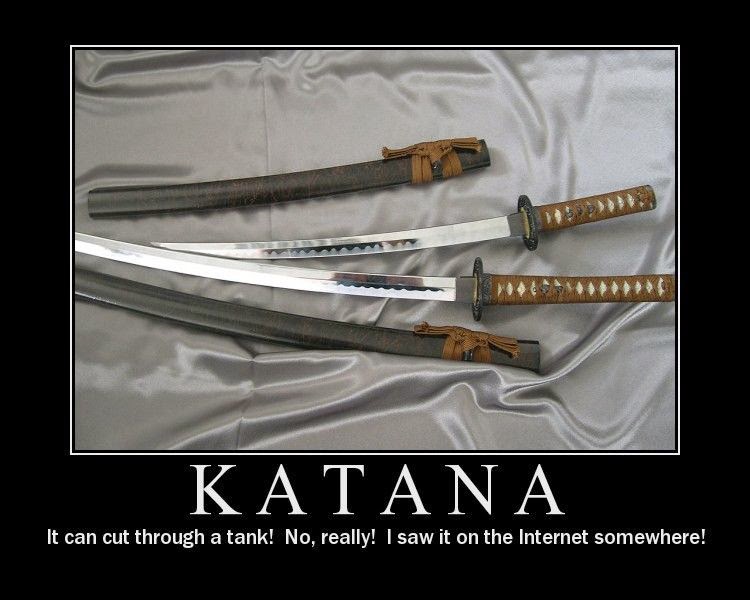


Cutting power. Holy cow do these weapons have that in spades. Not enough to chop through other swords like Hollywood likes to portray but dang, the combination of curvature, weight distribution, and keen edge all come together in lethal synergy. Because of the aforementioned issues with local ore, Japan did not develop armor in the same way as the rest of the world, and a thrusting sword was not as critical on the battlefield. With the full power of a two handed swing behind it, very little could stand up to these monsters.


Unfortunately this is also one of the katana’s greatest weaknesses. The edge is filed so keen that it is very brittle. Combine that with the aforementioned ore problems and you’ve got a weapon that will kill whoever you strike with it, but will more often than not be in need of serious maintenance afterwards, if it hasn’t been completely ruined. Miyamoto Musashi, one of the greatest swordmasters in history, was fond of saying that the best sword to use in battle was your enemies. Philosophical implications aside, he is literally correct. The swords were delicate, so he liked to disarm his enemies and kill them with their own weapon so he wouldn’t ruin his own. 


As an aside, Christopher Paolini’s characters discuss this issue in the third book of his Inheritance Cycle, Brisingr. While they’re not talking specifically about the katana, the principles brought up are essentially the same: a sword with a razor’s edge is delicate. With the Katana, the folding techniques used in the weapon’s smithing mitigate this, but do not eliminate it.


Another advantage of the katana was that it could be wielded in one or two hands, though using this
sword in one hand is actually much more difficult than in two given its weight. While there are few warriors who would consider the katana heavy in and of itself, in sword terms it’s no featherweight. Moreover, the weapon loses much of its cutting power when wielded one handed, forcing the wielder to rely more heavily upon the blade’s edge. The extended handle is excellent for maneuverability and leverage with two hands but can be a hindrance when wielding the sword one-handed. This is one of the primary reasons that shields were not common in Japan. Given the rarity of ore and the sheer cutting power of the katana, very few shields could withstand a two handed strike full on. And why limit your options with a weapon this potentially versatile? Especially since katanas came paired with a smaller version of itself, called the wakizashi. (side note: one day I will have to give this often overlooked short blade its own article).


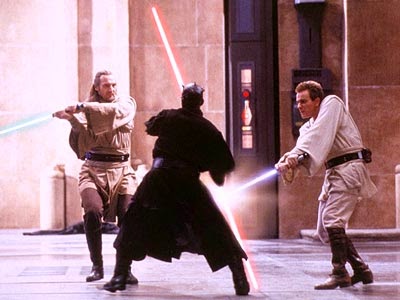
To summarize, the katana is a lot like the lightsaber in a lot of ways. Tremendous cutting power, rich history, and careful construction. The blade will likely stop whatever it hits, but will need work right after if it isn’t ruined due to the keen edge and, in older swords, weaker steel. Great for a one on one honor duel, not so much for fighting off hordes of zombies. Or an entire gang of yakuza. The golden rule for the katana: There can only be one.

Wednesday, April 8, 2015

WEAPONRY WEDNESDAYS: LIGHTSABERS

The first response on Facebook to last week’s post was “Psi Blades” and while not technically powered by psychic energy, lightsabers seem a logical step from that and let’s face it, this weapon is iconic. Complain all you want about Ewoks and Gungans or whatever George Lucas has changed, one thing this genius got absolutely right was the lightsaber. While technically science fiction, I don’t think many would argue that a major part of Star Wars’ appeal comes from its fantasy elements and in many respects, Star Wars has had as big an impact on fantasy literature as Tolkien’s Lord of the Rings. One cannot even think of a magic sword without comparing it to the colorful energy blades wielded by Jedi Knights in a galaxy far far away.

Part of the greatest appeal of the lightsaber is its uniqueness. While all lightsabers basically serve the same function and operate on the same principles, each is individually crafted by its wielder and has a distinct appearance. Those colorful blades are incredibly dramatic, but the hilts are equally distinctive. And since Disney purchased Star Wars, we’ve seen even more variation among lightsabers, from models that spin to those that have built in blasters. And of course The Force Awakens has the new hilted lightsaber. Considering the elegant simplicity of the weapon, I’m only surprised that this hasn’t happened sooner.

Let’s break into the pros and cons of these weapons from a more civilized age.

PROS

They cut through pretty much anything. There have been books and comics that describe materials that the lightsaber cannot cut through or even short circuits them when the blade makes contact, but none of them are cannon anymore. The only thing the weapon can’t cut through is another lightsaber blade and anything else only slows it down.

The weapon’s blade is also weightless, a huge pro considering their cutting power. You may recall from last week’s discussion of the war hammer that power equals mass times acceleration. The lightsaber doesn’t need to worry about mass, it relies on the energy emitted by the blade which is exactly as fast as the wielder’s reflexes. Imagine all those times you’ve played with a flashlight pretending it was a lightsaber and you actually wouldn’t be too far off. Coupled with the Force-enhanced reflexes of the Jedi and this weapon is formidable.

Finally, the weapon has omni-directional cutting power. In short, the wielder doesn’t have to keep track of an edge or angle the weapon a particular direction to cut, relying instead on the energy of the blade to do that for them. The maneuvers the traditional sword are limited to are no longer an issue with the lightsaber. No matter how you swing it, it’s going to cut something. Also, it never has to be sharpened!

CONS

Range. In a world of blasters, the limited reach of the lightsaber is a terrible detriment. There have been books that described models with extendable blades, but melee weapons simply struggle against those that can shoot. A perfect historical example is Henry V’s famous victory over the French in the Battle of Agincourt. Short version: the French were decimated by Henry’s use of the composite longbow. While the lightsaber is capable of reflecting blaster bolts, that requires exceptional skill, beyond human reflexes, and a masterful sense of timing. While all three of these things are found in Jedi, anyone else trying to use a lightsaber in the Star Wars universe is at a huge disadvantage.

Ergonomics. As aesthetically pleasing to my inner sci-fi nerd, most of the lightsaber hilts I’ve seen would be incredibly uncomfortable. While the Jedi craft their lightsabers individually so that they feel right in their hands (or whatever appendage our nonhumanoids prefer) those ridges, corners, and bumps are not something you’d want digging into your hand whenever you hit something. It weakens your grip and risks you losing your weapon.

No Guard. I realize that the new lightsaber from The Force Awakens’ trailer is a subject of hot debate, but hear me out. Most Jedi never actually get into a straight up lightsaber duel, so the absence of a hilt doesn’t really matter. To them, the lightsaber is more of a tool than a weapon. But when melee is the goal, a guard on your weapon is an absolute must. Honestly, I’m surprised the famous duel between Luke and Vader didn’t see one of their hands sliced off sooner. The lightsaber blade and hilt offer a straight line for an enemies’ blade to slide down unimpeded and lop off fingers, hands, or simply ruin the weapon.


In short, the lightsaber is a specialty weapon. It works in the hands of those with the capacity to utilize it to its optimum potential and its cons are largely circumstantial. The hilt can be made more comfortable (I think a wookie Jedi actually made one from wood), the lack of a guard rarely matters, and when you can leap buildings in a single bound and are fast enough to deflect something moving at the speed of sound, limited reach isn’t really an issue. SO, super abbreviated version: Lightsaber’s are great for Force users, but nobody else would last very long trying to take one into a battle where there’s anything other than melee weapons. Unless you mix in time travel—can you imagine the kind of damage a Jedi Knight could have wrought in the 100 year war? The Battle of Agincourt would have gone very different had the French had a Jedi capable of deflecting all those arrows and closing the distance.


What kind of lightsaber would you wield or what is your favorite lightsaber you’ve seen so far? Let me know in the comments below!

Wednesday, April 1, 2015

Weaponry Wednesday: War Hammers

Smashing its way into this new Wednesday tradition is the war hammer. Seems like a simple enough place to start. Stick some heavy metal on the end of a stick and start get to smashing. I mean, who doesn’t like smashing? The war hammer features heavily in fantasy literature and has gained a greater degree of recognition through Marvel’s Thor. However, the war hammer almost always plays second fiddle to the sword, often vying for this position with the battle axe, and rare is the weapon that is so misrepresented. 


Take Thor’s hammer, Mjolnir for example. The head is massive and the handle short. With virtually no reach, the weapon may as well be a glorified gauntlet and it’s actually the inspiration for Mike Mignola’s character, Hellboy. If it weren’t for its magical properties, and let’s face it, I don’t care how flawed a weapon is, if it let me fly and throw bolts of lightning I would take it, which is pretty much what Thor said, because in the original Norse legends, Mjolnir is flawed. The dwarves making it screwed up and made the handle much too short.

This was actually a pretty major problem. The reach of a weapon matters a great deal. While up close fights are dramatic for purposes of storytelling, most warriors preferred to be able to kill from the safest distance possible. The longer a weapon’s reach, the less chance a warrior was to get murdered before he could unleash some hurt. This is one of the many reasons for the popularity of the spear as an infantry weapon.

The other classic mistake in portraying a war hammer is to make the head absolutely ridiculous. I mean seriously, google “war hammer” or “fantasy hammer” and you will see that these heads are absolutely massive. Soldier’s couldn’t afford weapons that would force them to work that hard to wield them. Just hauling some of these designs to the battlefield would leave pretty much anyone exhausted. In actual combat, the weight of a weapon matters for two primary reasons, how fast it could be wielded and its penetrative powers.

I’m going to interrupt here to remind readers of a physics formula. I know—MATH! It’s absolutely terrifying and I will be the first to tell you that I am beyond horrible with numbers, but bear with me, this should be fairly painless. When taking the power of a blow into account, remember: FORCE = MASS x ACCELERATION. What this means is that speed is a critical part of the equation for dealing damage. Something too heavy, and you’re stuck relying entirely on its mass to power the attack. A second downside to tremendous amounts of weight is an inability to parry, or defend oneself. In short, it was much easier to make a weapon that could rely on speed dangerous than one that relied on pure weight, to say nothing of other practical considerations.
 
I think by now I’ve harped on the representation of war hammers enough, let’s take a look at what makes these things awesome. They’re WRECKING BALLS. As blacksmiths and armorers grew more skilled at working with metal, a lot of weapons had to work a lot harder to get at an enemy’s fleshy bits. The war hammer did not suffer this problem. Think of them as medieval can openers.

One side of the head was your traditional hammer, meant for crushing and use as a tool. The other side was a gigantic spike. The mixture of speed and weight focused on this singular tiny point could punch holes in pretty much anything. Have you ever had a woman in high heels walk on a hard wood floor? The floor gets completely wrecked no matter how dainty she is. Take that to the x power and you begin to understand the lethality of this weapon.

And the blunt end was no slouch either. While not as penetrating, armor didn’t really do a great job of absorbing the power of the strike before it reached the wearer inside. A blow that would be glancing from a sword or spear could crush a knight’s bones. This end tended to leave its victims alive more often than the other, but crippled. Monks in the far east actually liked using similar weapons because they could break men’s legs and not have to worry about killing them and breaking their vows. Of course, with the traditional weapon, this was very easily remedied with a follow through from the other end.

FAVORITE WAR HAMMER IN FANTASY LITERATURE

 
My favorite fantasy war hammer comes from Robert Jordan’s famous Wheel of Time novels. The character Perrin Aybara (who spends a great deal of the novels debating between the axe and the hammer—sounds kind of familiar, yeah?) forges a magical war hammer he names Mah’alleinir. A bit of a mouthful but still pretty dang cool and suitably intimidating. While this weapon is described as being more of an oversized blacksmith’s hammer than a traditional war hammer, it’s supernaturally light for its wielder and makes the enemies it strikes explode. That’s right, the bad guys EXPLODE. Seems a fair trade off for that spike to me.


What are some of your favorite war hammers, whether from history or fantasy? Let me know!